
There’s a skill separating the entrepreneurs who look successful from the ones who actually last.
It’s not louder marketing.
It’s not faster scaling.
It’s not chasing every new tool, tactic, or trend.
It’s something quieter—and far more powerful.
The most successful financial services entrepreneurs I see aren’t the loudest or the fastest. They’re the ones who know when to move—and when not to.
In 2026, that ability will quietly determine who builds durable businesses… and who burns out, overextends, or makes expensive mistakes they can’t undo.
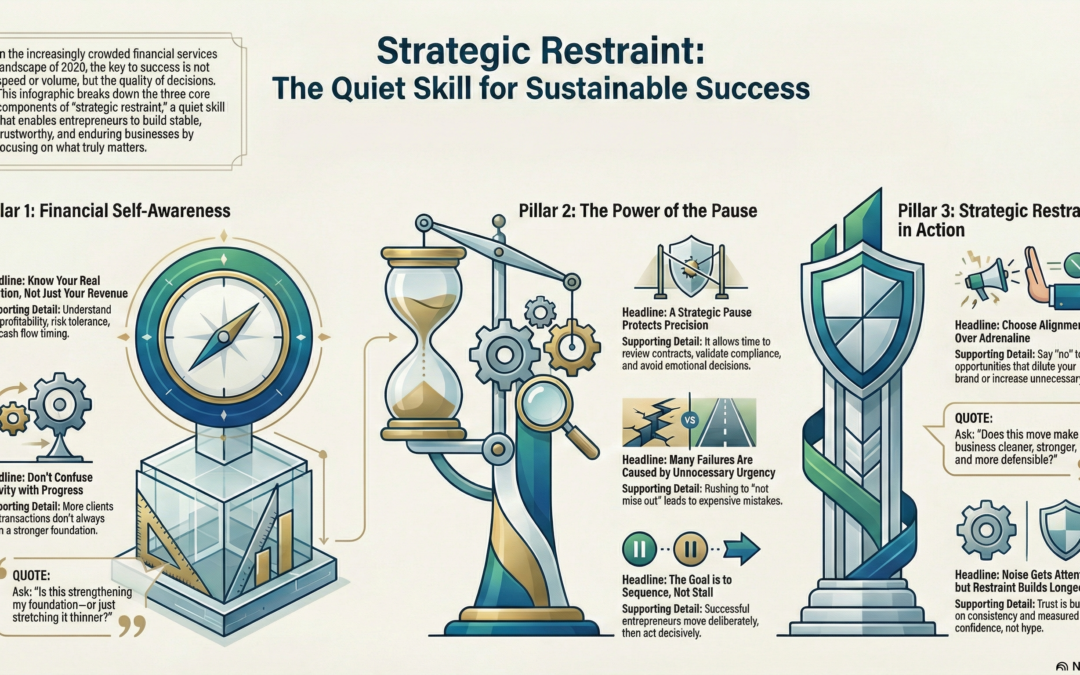
That skill is strategic restraint, rooted in deep financial self-awareness and the discipline of knowing when to pause.
Let’s unpack why this matters now more than ever—and how to build it intentionally.
Why 2026 Demands a Different Kind of Entrepreneur
The financial services landscape is changing, but not in obvious ways.
Yes, technology is advancing.
Yes, AI is accelerating processes.
Yes, competition is louder and more crowded than ever.
But the real pressure point in 2026 won’t be access to opportunity. It will be decision quality under constant noise.
Entrepreneurs are being flooded with:
- New offers every week
- New platforms every quarter
- New “must-do” strategies every day
And in financial services, every decision carries real consequences—for your clients, your compliance, your reputation, and your long-term credibility.
Speed without awareness doesn’t create advantage anymore.
It creates exposure.
That’s why the quiet skill matters.
Financial Self-Awareness: Knowing Your Real Position
Financial self-awareness isn’t just knowing your revenue.
It’s knowing:
- Where your income is actually coming from
- Which offers are profitable vs. just busy
- What your fixed obligations really are
- How much risk your business can truly absorb
Many entrepreneurs confuse activity with progress.
They see:
- More clients
- More transactions
- More partnerships
But they haven’t paused long enough to ask:
“Is this strengthening my foundation—or just stretching it thinner?”
Financial self-awareness means understanding your business as it is, not as you hope it will be.
That includes:
- Cash flow timing (not just totals)
- Dependency risks (single partners, platforms, or products)
- Personal financial pressure bleeding into business decisions
- Emotional triggers that lead to rushed choices
The entrepreneurs who master this skill don’t panic when something shiny appears. They evaluate it calmly against their real numbers and long-term goals.
That clarity alone creates an edge most never develop.
Knowing When to Pause Is a Strategic Advantage
Pausing feels uncomfortable in a culture that worships speed.
But in financial services, pause protects precision.
A pause allows you to:
- Review contracts instead of rushing signatures
- Validate compliance instead of assuming approval
- Stress-test an offer before scaling it
- Let emotional reactions settle before committing capital
Many business failures aren’t caused by bad intentions.
They’re caused by unnecessary urgency.
Urgency that says:
- “Everyone else is doing it.”
- “If I don’t move now, I’ll miss out.”
- “I’ll figure it out later.”
But later is expensive in this industry.
The entrepreneurs who pause don’t stall.
They sequence.
They move deliberately—then decisively.
Strategic Restraint: The Discipline to Not Chase Everything
Strategic restraint is not fear.
It’s not hesitation.
It’s not playing small.
It’s choosing alignment over adrenaline.
In 2026, restraint will show up as:
- Saying no to partnerships that don’t strengthen your core
- Declining clients who increase risk without increasing stability
- Avoiding offers that dilute your brand for short-term cash
- Resisting the urge to stack complexity too early
The strongest entrepreneurs don’t ask:
“Can I do this?”
They ask:
“Does this move make my business cleaner, stronger, and more defensible?”
Every yes has a cost.
Every expansion creates new exposure.
Every added offer adds operational weight.
Strategic restraint keeps your business light enough to adapt and strong enough to endure.
Loud Entrepreneurs Get Attention. Quiet Ones Build Longevity.
Social media rewards noise.
But financial services reward trust.
Clients don’t choose advisors, consultants, or financial professionals because they’re loud. They choose them because they’re:
- Consistent
- Measured
- Confident without being reckless
- Calm under pressure
Quiet mastery builds:
- Predictable income
- Stronger referrals
- Cleaner operations
- Fewer emergencies
It’s not flashy—but it compounds.
And in an industry where one bad decision can undo years of progress, that calm discipline is priceless.
How This Skill Shows Up in Real Life
You’ll recognize financially self-aware entrepreneurs by their behavior.
They:
- Review numbers weekly, not react monthly
- Separate personal stress from business decisions
- Don’t overpromise to close a deal
- Build systems before adding volume
- Choose stability before ego
They don’t rush to announce every move.
They don’t chase validation.
They don’t confuse growth with chaos.
They’re intentional.
And intention scales better than impulse.
Building the Quiet Skill (Step by Step)
This skill isn’t talent. It’s practice.
Here’s how to start developing it now:
1. Create Space for Reflection
Schedule non-negotiable thinking time.
No phone. No notifications. Just clarity.
Ask:
- What’s actually working?
- What’s draining time or money?
- What decisions am I avoiding?
2. Track Decisions, Not Just Results
Write down why you made major decisions.
Review them quarterly.
Patterns will emerge—and awareness grows fast.
3. Separate Speed from Progress
Before acting quickly, ask:
“If I wait 48 hours, will this decision improve or collapse?”
Urgent opportunities that disappear that fast usually weren’t aligned.
4. Define Your “No List”
Not just what you pursue—but what you refuse to do:
- Types of clients
- Revenue models
- Marketing tactics
- Partnerships
Restraint is easier when boundaries are clear.
The Entrepreneurs Who Win in 2026 Will Feel Different
They won’t look rushed.
They won’t sound frantic.
They won’t need to convince everyone.
They’ll move quietly—but with precision.
They’ll understand their numbers.
They’ll respect timing.
They’ll choose restraint over reaction.
And while others burn energy chasing everything, they’ll be building something that lasts.
Final Thought
The loudest entrepreneurs often get the most attention.
But the ones who master financial self-awareness, knowing when to pause, and strategic restraint build the strongest foundations.
In 2026, that quiet skill won’t just be helpful.
It will be the difference between surviving… and sustaining success.
“The most successful entrepreneurs I see aren’t the loudest or fastest. They’re the ones who know when to move—and when not to.”
E & S Direct LLC